
Boomer's Journal - A story in a matchbook
By Rachel Barduson of Alexandria
It’s a small paper folder holding a combustible sulfur material on the end of slim cardboard pieces – with a course, a striking surface on the outside that is used to start... a FIRE.
Matchbooks, back in the day, were of necessity, so to speak. They were used without much thought until they weren’t as available as they once were. I, for one, took them for granted. Their purpose was for convenience and to be discarded once empty. I did not think past that.
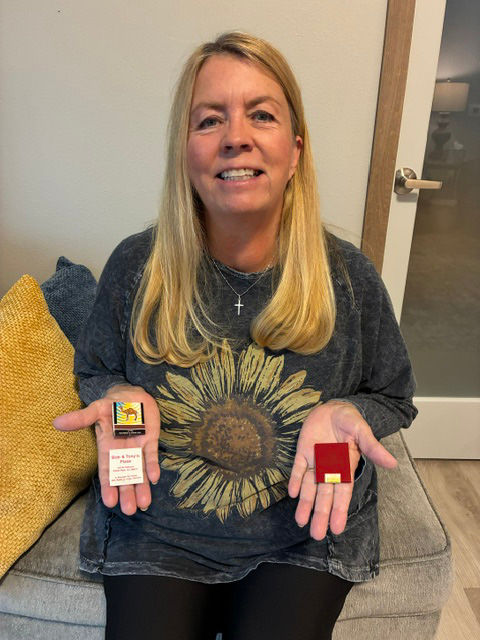
Who would’ve thought that a matchbook (unused) would be something to save?
Low and behold, I have a friend, Christy Meier, who DID think they would be something to save. She began collecting matchbooks way back in 1980 around the time when she and her husband, Gene, were married. Today, they have a bounty of matchbooks – a collection that happened quite by accident.
“I don’t even remember why we started to collect them,” she laughed. “We started to collect them and soon I had a bowl-full. Then I needed another bowl. Friends knew I was collecting and they would give me matchbooks with unique covers, messages, pictures or events. Friend’s weddings, our trips, restaurants we were at, hotels we stayed at. I found the glass pig (that now holds all of her matchbooks) at an antique store several years ago. Now its belly is full of matchbooks.”
The concept of matchbooks began in the late 1880s, a hundred years before Christy began collecting them. One account has a Philadelphia patent attorney, Joshua Pusey, patenting a match “folder” with comb-like matches inside and a striking surface also on the inside. A few weeks later, Pennsylvania entrepreneur Charles Bowman patented the modern matchbook design, placing the striker on the outside for safety. Pusey challenged Bowman’s patent, but it was upheld in 1894. Both sold their rights to the Diamond Match Company, which became the mass-producer of paper matchbooks.

Once this concept could be mass-produced, naturally the idea of promotional advertising of anything you could imagine went along with it. Abbreviated history of the matchbook includes the fact that the first known advertising matchbook was created in 1893 or 1894 by the Mendelson Opera Company, which hand-printed promotional messages on blank covers from the Binghamton Match Company. Inspired by this, Diamond Match salesman Henry Traute began encouraging manufacturers to advertise on matchbooks, promoting them as a daily-use promotional tool.
The first big promotional sale using matchbooks as advertising canvases was from Pabst Brewing Co. for an order of 10 million matchbooks.
Almost immediately, matchbook covers became advertising canvases. This inspired the birth of a new era in the American match manufacturing industry. The exterior of the match-cover was usually imprinted with a producer’s logo, often with artistic decorations, and Christy has her favorites. The slim design of a souvenir from Italy or the interesting design from Las Vegas “Where the Hidden You comes out to play!” – are just a few. The ease of mass-producing and making matchbook-covers of different shapes also made them quite a popular – and cheap - promotional item or souvenir. Christy’s collection includes friend’s weddings, anniversaries, or other memorable events.

Christy enjoys looking through her collection – especially those books with slogans. One of her favorites says “A Stranger But Once” Bill, Maddie & Linda, Owners - from Bob & Tony’s Pizza in Estes Park, Colorado.
Back in the day it seemed that most everyone carried a matchbook with them because there always seemed to be a need for a match. For whatever reason, including smoking, back in the day, I would bet that many carried matchbooks in their pocket or purse. I remember watching “Let’s Make a Deal” and at the end of many episodes, a fast deal could be made if someone could find a matchbook in their purse – with a $100 prize if they did.
“I can still smell the sulfur when a match was struck,” Christy said, reflecting on building a campfire and camp cooking. The couple met in Peoria, Illinois, Christy’s hometown, and relocated to Alexandria, Minn., in 1997, when Gene accepted a job at Bremer Bank as a mortgage lender. She still has many matchbooks from Peoria – including places that no longer exist. Places that have gone out of business; or places that have burned down – like The Rose – a restaurant in Peoria that burned down in the ‘90s; or places that were torn down. Christy’s matchbooks are a big part of what’s left that go along with the memories that were made. The weddings of friends, trips friends took – and trips Christy and Gene went on themselves.

Matchbook production peaked in the mid-20th century during the 1940s and ‘50s, but began to decline due to disposable cigarette lighters, anti-smoking campaigns, and high labor costs. The match industry collapsed in the mid-1980s, and by the 1990s, matchbooks were largely obsolete.* Christy must have had some kind of sixth-sense premonition to have begun her collection in 1980.
Little did Christy know until now that she is a “phillumenist” or “lovers of light” – what matchbook collectors are known as. She is one in a population of many that have a shoe box or fish bowl – or in Christy’s case a glass antique pig – full of hundreds of different topics, restaurants, hotels, entertainment, sporting establishments, and of course, from Morehead City, North Carolina, where Christy’s father was born and raised, and a favorite vacation destination for her family.
According to Matchbook History, the most expensive matchbook cost $6,000 in 2015. The matchbook was created for a rare Charles Lindbergh dinner celebration dated June 14, 1927. The matchbook is missing four matches, but is otherwise in mint condition as the cover is considered the collectible grade. It is believed that “The Lindbergh Matchbooks,” as they are known, were discarded as they were printed with the rank of Captain; because, with the world-famous achievement by Lindbergh, he was promptly promoted to Colonel. It is estimated 200 of these books were handed out at a dinner in his honor at the Astor Hotel in New York City. At last count there were about 13 known to exist.
Christy has lost count of how many matchbooks she has in her collection. Just think, maybe somewhere in the belly of her antique glass pig sits a collectible that no one else has. For certain, any time she starts going through her collection, the memories are spurred and the conversation begins.


Comments