
Four who served in the 'Forgotten War'
Life stories of Murray County Korean War Veterans
By Gary Kass
After The Allies complete victory in World War II, America arguably became the primary power in the free world and the only nation to have nuclear armaments. The nation shifted its focus from war to peace, growth, and the pursuit of prosperity. The armed forces were largely demobilized and all matter of military equipment was put in storage, sold, or just scrapped. Even as the Iron Curtain descended across Europe, our supremacy in the free world was assured. That premise was exploded on June, 25, 1950, when North Korea invaded South Korea. The US was not really prepared for this conflict, but was obligated to defend South Korea against the Communist invasion.
The young men of Murray County put aside their peaceful lives and did their part to serve our nation and keep the people of South Korea free. This is the story of four such men who have recently departed.

On May, 25, 1929, Alvin G. Hoffbeck was born on the family farm near Redwood Falls. He graduated from high school in 1949 and then joined the Minnesota National Guard in 1951. The Guard was activated on Jan. 16, 1952, and sent to Camp Rucker, Alabama for training. Hoffbeck was in the company’s 4th platoon, but the Army had reorganized the structure of a company to eliminate the 4th platoon. So, Hoffbeck and the others from his platoon were ordered to Korea.
In Korea, Hoffbeck was assigned to the 25th Division, 35th Regiment as a tank loader. A loader’s job is hard, dirty work in tight spaces, but he did it well. He fought in battles adjacent to the Punchbowl and in an area now famous for hard combat known as Heartbreak Ridge.
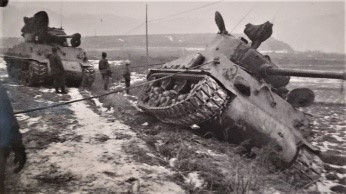
Hoffbeck was badly injured by enemy artillery fire on Heartbreak Ridge in April, 1952. He was evacuated to the rear where he underwent surgery and then physical therapy. About six weeks later he was returned to his unit only to find he could no longer perform his duties due to his injuries. On Oct. 8, 1952, he received a medical discharge with significant disabilities.
After returning to Minnesota, Hoffbeck met his wife, Ardith Likness and they were married on June, 5, 1953. Together they had four boys and one girl. He farmed near Redwood Falls until moving to Murray County where he farmed for many years before retiring and moving into Tracy. When asked if he has any regrets about serving, Alvin said, “I don’t regret doing it… I was happy to go over there and help defend the United States.” Alvin passed away in 2019 at the age of 90.

Dean Bundy was born near Oelwein, Iowa in 1932. He grew up on a farm near Spirit Lake, Iowa, graduating from there in 1951. He continued to work on his parents’ farm until he was drafted in 1952. Bundy was sent to Fort Sill Oklahoma for Basic Training. After graduation, he then attended the Field Artillery Survey Course. He was then sent by troop train to Seattle, Wash. and shipped out to South Korea.
Arriving in Korea, Bundy joined an artillery unit which was near the 38th Parallel. There, he was assigned to do survey for the artillery. When asked what that entailed, he replied, “Survey would go out and survey the landscape for mines. We had to be… out ahead of the troops. I didn’t like that. I got a chance to get transferred to the quartermasters, (supply) so that’s what I did.”
In the unit’s supply section, Bundy was responsible to issue supplies, ammunition, and other essentials to the unit’s soldiers. Bundy was happy that he got transferred from survey back to the company’s supply area, but even then there was danger. He remembers, “One fellow there was named John Holm. He had served time in the second World War. He got hooked into the Korean War, because he was a single guy. He took ammunition to the front lines all the time he was over there… and he never got a scratch. He got his orders to go back to the States (and) he was in the dispatch shack. There was a caterpillar sitting up on top of a hill (behind the dispatch shack). I don’t know what happened, if it came out of gear, or if the brakes failed… but this big Cat rolled down the hill, ran over the dispatch shack and killed him. He had just a few days left… I will never forget that.”
After Bundy finished his tour in Korea, he was discharged and returned to Iowa. Bundy started farming there, but eventually his family bought a farm in Murray County. In 1969, Bundy married Hazel Bennett who was previously married and had three children of her own. Hazel and Dean then had two children together. After his parents passed he continued to farm the land, buying other parcels as well. In 2012, Hazel passed away and Bundy continued to live on the farm in Lake Sarah Township, eventually turning over the farming to his son David.
When asked about his service, Bundy said, “I didn’t do anything important.” Bundy contends he did not do much, I disagree. Dean served his country when called and faced many dangers in Korea -- he did his duty. Dean passed away on July, 31, 2021 at the age of 89.

Richard Lanners was born on June 14, 1931 on a farm near Iona. He graduated from parochial school there in 1949. He helped his parents on the farm for one year, then joined the Navy. He was sent to Great Lakes Naval Training Center for Basic Training, then advanced training at Norfolk Virginia Naval Station. After advanced training, Lanners was assigned to a submarine tender the USS Bushnell. Each submarine tender had 12 submarines assigned to it and the Bushnell took care of all their needs. Lanners worked in the ship’s Commissary Department and he said, “I ordered all the groceries for the ship and the 12 submarines.”

Lanners was discharged from Key West, Fla. and returned to Iona to help on the farm. In 1959 he married Patrica Illig and they had four children -- three girls and one boy. He continued farming near Iona for many years until moving to Slayton to retire. Pat passed away in 2015. His son continued on the farm, but Lanners helped him with fieldwork.
When asked to reflect on his service, Lanners said, “It was the thing to do at that time… but some guys went through a lot more than me.” Richard Lanners passed away on June, 16, 2021 at the age of 90.

Paul Beech was born on Dec. 21, 1931 in Iona. He grew up on a farm northeast of Slayton and attended country school before transferring to Slayton High School. After graduation, he worked for a time, then joined the Navy and was sent to San Diego for Basic Training in 1951.
After Basic, Beech was trained as a boat repairman and assigned to the USS Estes (AGC-12), a command and communications ship. One of his permanent responsibilities was to pilot the ship’s boats and landing craft. The ship was sent to Korea’s west coast to debark Marines in and around Inchon after they had secured it in 1950.
The Estes was next assigned to “Operation Ivy,” the nuclear bomb tests in the Marshall Islands. Beech piloted a landing craft and was charged to go directly into the area right after the nuclear detonation. Many of the “Atomic Veterans” met early demises due to radiation exposure. Beech told me that when the USS Estes was scrapped (in 1969), even the hull was found to have high levels of residual radiation.
The ship’s next port of call was French-Indochina (Vietnam). The USS Estes was part of “Operation Passage to Freedom,” a joint US/French task force to relocate over 300,000 Vietnamese civilians from Communist North Vietnam to South Vietnam. Beech was assigned to assure the security of Vietnamese refugee camps near Saigon. It was dangerous duty; Communist forces were in the area and actively looking to capture or kill French forces and their US allies.

In early 1955, Beech and other shipmates were sent to Japan for out-processing and flight back to the US. Beech said, “The guys lined up to go on a plane to Hawaii…(but), they didn’t have room for me and three other guys.” Instead, Beech and the others were put on a later flight to Hawaii. When they finally arrived there, Beech was told the plane that they were originally scheduled to be on crashed on the side of a mountain in Hawaii. He said, “All the guys I knew… dead on the side of that mountain!” (Editor’s note: On March, 22, 1955, an R6D-1 military aircraft bound to California, with 55 servicemen and two dependents crashed in Hawaii due to bad weather, all aboard were killed).
After four years of adventures and dangers, Beech struggled to fit in to civilian life. PTSD was not well understood at that time, but he was sent to a trauma treatment program and that helped him to gain a perspective on what he had been through. After that, he started farming north of Slayton. Beech had married his wife Norma Jean Bloom right after Basic Training and they were to have seven children; the youngest boy died at nine months of age.
In retirement, Beech lived independently on his farm. Norma Jean passed away in 2006 and his son Mark now did most of the farming, but Paul continued to help with chores and fieldwork. Paul passed away in February 2024 at the age of 92.


Comments