
Historic PO mural dates back 87 years
Long Prairie Post Office mural commissioned in 1939 during Great Depression
By Tim King
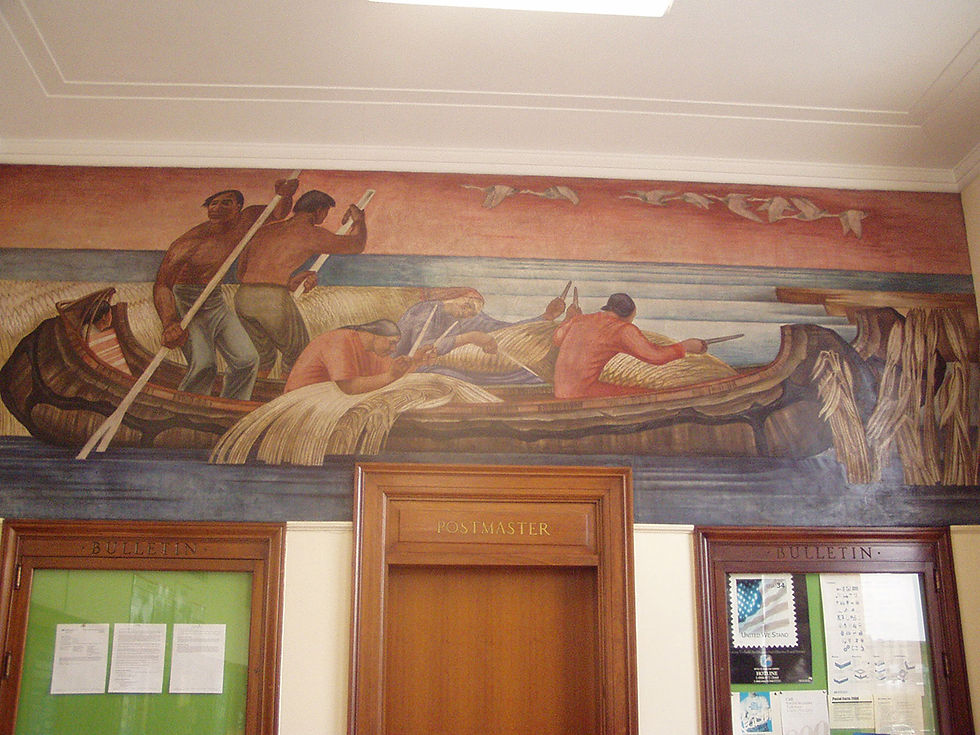
For the last nine decades, visitors to the Long Prairie Post Office wishing to do the common task of mailing an envelope have had the uncommon opportunity to view a large mural called “Gathering Wild Rice.”

The large mural covers the entire wall above the door labeled POSTMASTER. It portrays two canoes being poled, from the stern, through a wild rice bed by two muscular men. At mid-canoe two women, their backs rounded toward their labor, beat the rice.
In Lucia Wiley’s 1939 Long Prairie Post Office mural, she portrayed men and women doing hard physical labor amidst great beauty. As the four bend into their labor, a flock of swans is crossing the upper right quarter of the art work. They, and the humans, are bathed in a rose colored sun set. The water is pale blue where water and sunset meet, but it fades into a dark indigo towards the bottom of the painting.
Wiley’s mural was among hundreds of public works of art commissioned by the United States government during The Great Depression.
“Artists have got to eat just like other people.” That seemingly meaningless statement, made by Franklin Delano Roosevelt’s relief administrator Harry Hopkins, had special meaning in Minnesota in the 1930s and early ‘40s.
In some places unemployment was more than 70 percent and starvation was not unheard of. To keep artists fed, and to inspire Minnesotans, the government commissioned art work to be placed in public buildings.
Post Offices, which were visited routinely by most people, were the logical places to put the art work. Especially since FDR’s Works Progress Administration had been busily building post offices, courthouses, and other government buildings as part of an effort to put people back to work.
The Long Prairie Post office was part of that wave of construction and had been completed in 1937, two years before Wiley got her commission to create Gathering Wild Rice.
While the Long Prairie Post Office was under construction by WPA workers and architects, Wiley was working on the completion of another Post Office mural in International Falls called “Early Logging at Koochiching Falls.” The 12-by-8-foot mural also shows muscular workers laboring at the business of logging. At the center of the work is a man driving an equally muscular and powerful oxen across the top of the painting.
In addition to Wiley’s two murals the U.S. Treasury Department’s Section of painting and Sculpture commissioned twenty-four other murals, paintings, and sculptures in post offices.
The artists used wood, oil on canvas, tempura on canvas, egg tempura on plaster, and just tempura as the medium of their creations. Wiley’s two Minnesota murals stand out because she used true fresco as her creative medium.
True fresco is what Michelangelo used when he created “The Creation of Adam in the Sistine Chapel” during the years from 1508 to 1512. The Mexican muralist Diego Rivera revived the technique in the early part of the 20th century and was still working with it when Wiley was working with fresco in Minnesota in the late ‘30s.

Murals created by true fresco are not actually painted in the conventional sense of painting with a brush and a palette. Fresco is a difficult technique of painting to master, executed upon freshly laid, or wet, lime plaster. Fresco artists use water as the vehicle for the dry-powder pigment to merge with the plaster. When the plaster sets the painting becomes an integral part of the wall.
Wiley didn’t create any more Post Office murals in Minnesota, but she went on to receive commissions for one in Shelbyille, Illinois, and another in her home town of Tilamook, Oregon, among others. She also created the “Making Camp on the Red River Trail” mural for the Moorhead High School.
Like her contemporary, Diego Rivera, she could be controversial. In 1947 she painted “Northern Nativity” for the Ashland Wisconsin Post Office. The painting was a huge 18-by-10-foot canvas that portrayed the first doctor in Ashland attending a birth in rustic conditions. The Postmaster found it objectionable and refused to accept it.
Wiley received her training to pursue her work in Oregon and Minnesota.
“Following some post-graduate study at the Minneapolis School of Art at the Minneapolis Museum of Art, Wiley accepted a full time teaching position at that school in June 1933,” the Oregon Encyclopedia writes.
But then she became a victim of the Depression herself. The Depression caused the school to cancel her contract before school started. For the next three years she gave fresco workshops for the Minneapolis School of Art and pursued her growing expertise in fresco artistry via the Post Office projects.

By the mid-1950s Wiley is commonly referred to as America’s most prominent practitioner of the art of fresco. But, she said in a 1996 interview, she wanted a more meditative life. At the time she was back in Oregon.
“She resigned from the Portland Art Museum to become a postulate at the Episcopalian Community of the Holy Spirit at St. Hilda’s House in New York City,” writes the Tilamook County Historical Society in the biography of Wiley.
Wiley eventually became Sr. Lucia and, in time, became a leader in the order.
For those seeking to find more uncommonly good public art in Central Minnesota, a visit to the Sauk Centre Post Office will be rewarded by a viewing of Richard Jansen’s 1942 oil on canvas “Threshing Wheat.” The website “New Deal/WPA Art in Minnesota” has a complete list of Post Office public art that was installed. Call before you go, however. Some of them are no longer there.


Comments