
'Save the last three bullets'
St. Cloud man was a baby, living at Pearl Harbor, the day of the attack
By Nikki Rajala
Editors Note: There are words in this article that are deemed offensive today but were kept in the article as they are historical, direct quotes from 1945
“Sunday, Dec. 7, 1941, 9:45 am, near Hickam Field
“I was just fixing coffee at 8 a.m. when the first bomb dropped in the Navy Yard a half mile away. I rushed out thinking a plane had crashed and saw about 20 Japanese planes in the air, flying so low that the red sun painted beneath the wings was plainly visible. Later some flew not a hundred feet over our house; ... our ears certainly didn’t deceive us, nor the sight of dozens of bombs being dropped.
“The first bomb made a direct hit in the Navy Yard and black smoke rolled out. In five minutes, two of our hangars had been hit. How clever of the Japs to know that usually our planes are grounded on Sunday! How did an aircraft carrier get in close enough to let the airplanes bomb us? Twice there were terrific dog fights right over our house — low, because the anti-aircraft was shooting at the planes higher up.
“The water and electricity are both off — were hit right away. For about one-half hour there have been no bombs. Such a din — machine guns, anti-aircraft bombs falling, explosions and smoke everywhere. So this is war!”
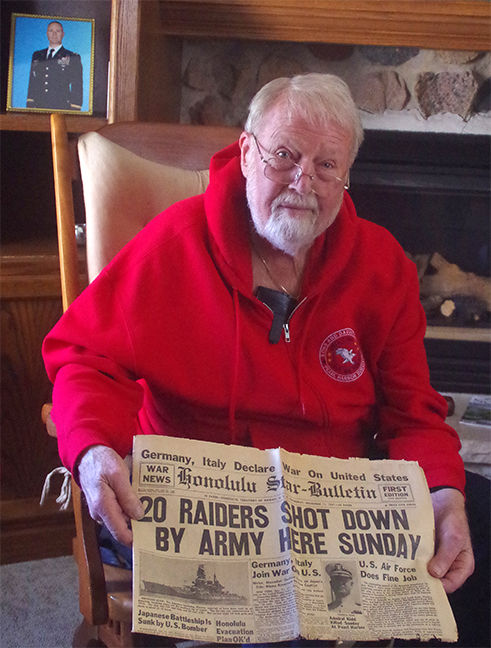
Bess Johnston wrote those words to her in-laws, describing the chaos. When her son, Nick Johnston of St. Cloud, now 85, read aloud her letter, he choked up — still feeling her anxiety as she struggled alone with him, 3 1/2 months, and his sister Jackie, 6. Nick’s father, 1st Lt. Charles Johnston and the commanding officer of the 481st Company, Aviation (Bombardment), immediately returned to his work at Hickam Field after the first bombs dropped.
“Dad joined the Army Air Corps in 1941,” Nick said, “received specialty training in ordinance and was assigned to Hickam Field, Territory of Hawaii, as a second lieutenant, dealing with everything from rifles and ammunition to bombs, planes and anti-aircraft. By December, he’d made first lieutenant. Our quarters were blocks from the airfield runways.”
Though his dad had intended to work in their yard that Sunday morning, instead he mobilized. His father wrote:
“When I heard first bomb explosion, I thought it was a training accident where a Navy pilot had dive-bombed on the island. With the second bomb, I thought the same pilot crashed. I rushed out to see a Japanese fighter pilot flying from the direction of the flight line. When I saw the red ball under his wing, I knew what was happening.
“I looked at my family, thinking I might never see them again, and told them to stay inside. Then I went back inside and got fully dressed — we could get in trouble for not wearing a tie. I knew we were at war.”
Bess and Chuck shifted rapidly to surviving the crises of war.
First Nick’s father returned to lead his unit and later returned to help his family:
“I drove my car to area where two-thirds of my command was present. I assembled the men, moved them on the run to our motor area, secured our equipment and then moved them to the bomb dump a mile and a half away.
“After the second attack, I drove to my family quarters, packed a case of canned milk, a .22 pistol and 500 rounds of hollow-point ammunition. I told my wife to shoot all the Japs you can, but save the last three bullets for the kids and yourself.”
“They expected Hawaii would be invaded and Dad thought we’d be taken prisoner,” Nick said. “He showed her how to use the pistol and said to drive to the “Punchbowl Cemetery,” in an extinct volcano overlooking Pearl Harbor, where she could see everything, and kissed us goodbye. Then he went back to work for the next 72 hours, securing and loading munitions. After that, we didn’t see him again for two years.”
The U.S. officially declared war on Japan on Dec. 8, 1941.

Nick’s father described their equipment on Day 1: one WWI flat helmet and a gas mask for every man, five officers and 21 NCOs; a .40-caliber pistol with 20 rounds; and 10 .30-caliber Springfield rifles with 50 rounds each.
During bombing lulls, Bess managed to write:
“11:45 a.m. Four Japanese planes have been shot down — three in flames. The radio stations have been shut down by Army request so we have no news. … Mokapu Point was also bombed this morning; don’t know about Wheeler Field. Two of our hangars were bombed three blocks from our house and all the planes in them. … There they go again! The flames at Hickam are almost died down but the Pearl Harbor oil tanks and ships are still burning.”
At 3 p.m. she drove to the Iolani Palace, where the Red Cross fed them their first meal that day and directed them to places where refugees of Hickam Field and other Oahu military bases would be taken care of.
“Red Cross workers showed up at all military bases on Oahu,” Nick added, “referring military dependents to temporary refugee housing at the University of Hawaii. The dependents needed places to stay but couldn’t return to Hickam without water, electricity — or air raid shelters.”
Bess continued:
“Saw bomb crater in Palace grounds 20’ in diameter by 4’ deep. Understand several civilians have been killed and injured and I don’t know how many Army and Navy boys. Enemy ship sighted at 2 p.m. ninety miles off Barber’s Point. ... I can think of lots of things I should have brought.”
The next morning Bess wrote more:
“Monday, Dec. 8, 1941, 9 a.m.
“Nicky is asleep and Jackie is playing in the gym. After the children were asleep last night, I went out with four other cars on Army missions — driving without lights, delivering soldiers, guns and ammunition to various parts of the city. Driving in the city at night without lights is some experience! The only planes we’ve seen this morning are our own and they are beautiful!
“Thursday, AM Dec. 11, 1941 = Another long blackout night is gone. We’re always glad to see the dawn. We hope we can go back to Hickam Field in three or four days, when the bomb shelters are completed. I was allowed to go there yesterday for 1/2 hour to get necessary clothes ... Chuck calls each night.
“Not an ordinance man of the three companies was lost. Not more than 500 killed in all Army posts on Oahu ... Saw only three bombed quarters. Navy dead will probably reach several thousand.
“Island civilians — 49 dead, 100 injured. Picked up piece of shrapnel yesterday and blew out a tire. Chuck was able to shave and change clothes last night for the first time since the raid. … Women and children may be evacuated soon because of a possible food shortage.”
In Nicky’s baby book that year, Bess added poignant notes:
“Baby’s First Christmas
“Nick’s first Christmas was spent at Hickam Field, 18 days after the Japanese attack on that field. Only thing to make that day different was an air raid alarm during the afternoon. Christmas trees were unavailable.”
“Baby’s First Outings - Dec. 30, 1941—Sailed aboard “Tasker H. Bliss” U.S.A. from Honolulu. T.H., pier 24, for San Francisco. Convoy of 3 transports, 1 tanker, 4 destroyers, one cruiser and airplane patrol. Arrived San Francisco Jan. 6, 1942 ...”
“We left Hawaii in the second convoy, zigzagging across the Pacific to get to the mainland,” Nick said.

About three years ago, Nick added these family recollections to those of children of servicemen stationed in Hawaii, and founded the Minnesota North Star Chapter of the Sons and Daughters of Pearl Harbor Survivors (SDPHS), a national organization of descendants of military personnel stationed at Pearl Harbor and other military installations on Oahu, Territory of Hawaii, on Dec. 7, 1941. The group has over 4,000 members in all 50 states, foreign countries and some currently serving in the military.
“Descendants are becoming the primary keepers of history as the original survivors like my parents have passed, and we descendants are also passing,” Nick said. “Our group meets three times a year, in person and by Zoom, to preserve our stories. Dad’s recollections and Mom’s letter about the first days were in their applications for joining SDPHS. When I read their accounts today, I’m struck by the enormity of what they faced. Sharing those moments is important for me.”
He believes that since all members of his family survived the war, he must still be here for a reason. Part of that is to share his family’s story, and gather those of other family survivors. As an Army veteran himself, he continues to serve other veterans through various volunteer activities — and hopes that anyone who has stories to share will contact him at 320-333-5336.
As frightening as the attack was, Bess reassured her in-laws in that first letter back home:
“Please don’t worry, as Jackie says, ‘God does hear our prayers. He made the Japs go away.’”


Comments