
‘Ye Editor’
Tribute to a small-town weekly newspaper man (and my grandpa)
By Lynn Kuehn of Redwood Falls (Formerly Echo)
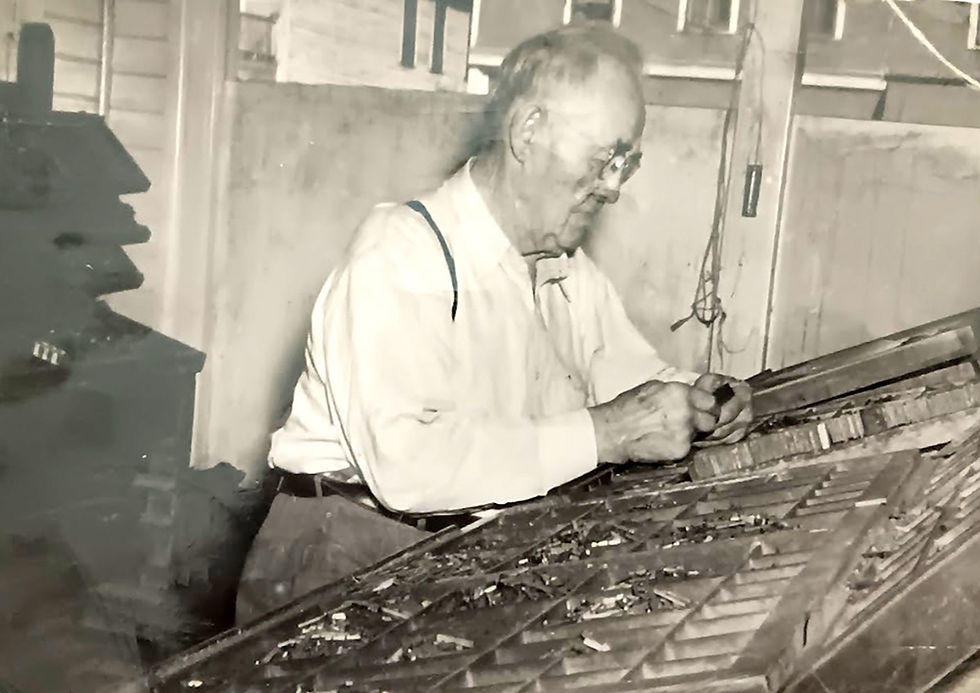
This is a story about newspapers. Most especially, it is a testimony on small-town weeklies and the legendary generals who headed them. While there were many such newspapers back in the day, Echo Enterprise is the small-town weekly to be honored here.
While the Enterprise was one of those esteemed weeklies, its longtime editor bears equal attention. The man who was the editor and publisher of the Enterprise for 54 years of the paper’s existence was George B. Hughes. George was a modest man, who wrote his name, simply, Geo. B. Hughes and spoke of himself in print as “Ye Editor.” He used the journalistic “30” to sign off his editorials.
George Brenton Hughes was born on May 6, 1862 in Nicollet County, near the area where the Sioux Uprising would occur shortly. His family moved to St. Peter, where he later graduated from high school. He became interested in the newspaper field when as a student he wandered into the St. Peter Tribune; here he learned the craft from the ground up.
As an adult he continued his intentions by working in area papers. He became foreman at the Marshall Independent, where he met a little lady named Mattie Maxson, who was a compositor there. Note: A compositor is a person who arranges type for printing using a process called handset.
First a newspaper, then a wife
George expanded his pursuit of newspapering in Redwood Falls, where the possibilities in the Redwood Reveille led him to purchase the paper; the year was 1890. Now an established editor and publisher, the young man’s fancy turned back to the lovely Miss Mattie, waiting patiently in Marshall. After an appropriate courtship, George Hughes and Mattie Maxson were married May 6, 1891 in the Marshall home of the bride’s brother, Attorney Orrin Maxson. They made their home in Redwood Falls, where Mrs. Hughes became her husband’s most prolific compositor. In time, children, Sibyl and Maurice, were born.
George led the Reveille successfully for eight years before he resolved to sell. The year was 1890 when he moved on to receive the postmastership of Redwood Falls. While the post office grew steadily under his hand, in time his attention turned back to his love of newspapering. This longing caused him to take a look at the Enterprise in Echo some 20 miles westward.
Echo Enterprise
Echo Enterprise was established in 1894. During its first years of existence, several editors were at the helm. In 1905 Geo. B. Hughes went into partnership with S. G. Peterson to become co-owner/publisher of the weekly newspaper. George became the editor-in-chief, then gained full ownership in 1907. It was said at the time, his stay at the Enterprise was temporary.
Unforgettable Day
An unforgettable day in July of 1907 was one which would live forever in the hearts of the Hughes family, as well as in the collective memories of the Redwood Falls community. The stories in both the Redwood newspapers, the Reveille and the Gazette, related how one summer afternoon three girls donned their bathing attire and walked to Lake Redwood.
The account related that two of the three girls drowned that fateful day. George and Mattie’s 13-year-old daughter, Sibyl, was one of those girls. It went on to say that George was at work in Echo. When notified, it took him two hours by horse and wagon to reach his grieving family.

Family moves to Echo
When George became editor, then publisher of the Enterprise, it was said his time there would be temporary. Following that sorrow of Sibyl’s death, come October, George moved his saddened family to Echo, where they were to remain. Here in Echo, a third child, Leland, was born to them.
Age of the Automobile
As early as 1912, the automobile made its presence known on the rural scene. In competition with several Echo dealerships, George went into partnership with F. A. Schroeder to sell Grand Maxwells.
Editor shares world news
Throughout the years, George editorialized in the Enterprise on events on all levels. Among those items were the 1912 loss of the ill-fated Titanic on her maiden voyage and the torpedoed Lusitania in May of 1915.
World War raged from 1914-18; the US entered the fighting in 1917. Editor Hughes wrote intently about the war, including President Wilson’s negotiations with Germany. As the fighting ended, Ye Editor’s words heralded “... the promise of being the merriest Christmas enjoyed by the world’s people since that most joyous celebration of the birth of the Prince of Peace...”
An armistice between Germany and the Allied Powers was signed on Nov. 11, 1918. The ceasefire, which went into effect at the 11th hour of the 11th day of the 11th month, became immortalized in the annals of American history. In time the event was renamed Memorial Day.
The title World War was changed to World War I within the next 20 years when Hitler and the Nazis repeated their chaos around the world. The US became fully involved in the combat after Pearl Harbor was attacked by Japan on Dec. 7, 1941. This horrendous event plunged the US and the entire world into what would become World War II. The war ended in the fall of 1945.
George wrote extensively on the progression of the war: “Franklin Delano Roosevelt became president for a fourth term;” “Hitler’s reign badly interrupted... Italy falls... Japan given ultimatum;” “Terms of surrender signed on Battleship Missouri on Sept. 2, 1945.”
During the war, local men, turned soldiers, wrote letters to George telling him of their current situations. George shared these treasured letters with the folks back on the home front by recording them in the Enterprise. As a way to bring cherished news of life back home, George mailed Enterprises to the “boys over there.”
“Locals” held their own
Amidst the myriad of stories, columns, and everything else that became a part of these small-town weeklies, the locals held their own prominence. Scattered among these locals were the occasional musings of the hunting and fishing activities of the men of Echo. Those reported outings were humorous, challenging, and often somewhat exaggerated. With a sort of twinkling of the eye, George wrote both in praise and in jest of the prowess of the local men, himself included.

George took many tours around Minnesota, where he always reported on the state of the crops. He revered the farmers throughout Siouxland. As a tribute, just before the paper went to press each week, the day’s markets were placed on the front page.
Along with his Minnesota excursions, George, at 87, 88, and 89, ventured on train trips to Beaumont, Texas, to visit his son, Leland and his family. The family had left Echo several years prior and journeyed annually to see him in Echo. It’s important to note: In a short number of years, further changes would bring George’s family home to live and work in Echo.
Geo. B. Hughes Recognition Day
It was the spring of 1955. Echo was a flurry of activity. This sunny day in May had officially been declared “Geo. B. Hughes Recognition Day.” A proclamation was declared honoring George on his 93rd birthday and in recognition of his 76 years as a printer. George had been in service to the citizens and community of Echo for 50 years.
Of the event, George editorialized: “Last week I told you ‘fifty’ years is not a long time – it is only yesterday. May I say just: ‘God bless my own Echo people and all of our Siouxland.’”
Scott Schoen, president of Minnesota Editorial Association, spoke in honor of George. On behalf of the MEA he presented George with a gold makeup rule, a valued tool of the trade. The engraving boasted: George B. Hughes, 76 Years a Newspaper Man.
Enterprise for Sale
In time, George made the difficult decision – The Enterprise was for sale. He could go on alone no longer; he asked his only remaining son for help.
George’s fame spread far and near those days. In 1959, Miriam Alburn and famed photographer Earl Seubert of the Minneapolis Sunday Tribune were dispatched to Echo to capture George’s story in print. He had had the paper for sale for some time, thus, their Tribune article was headed: “State’s Oldest Editor Thinks 96 Is Time to Sell.”
Many deserving words were attributed to George in that fine story. The article ended: “But the old editor, who started his newspaper career in 1881, still, as in years past, wears his hat in the shop, wears no coat outdoors, and walks the main street of Echo with a jaunty air.”
The big newspaper people came to Echo, did their story, then went on their way back to the big city. We all, including the entire community of Echo, were well pleased for that one, brief moment of fame. In fact, we all rode on the coattails of Ye Editor, himself.
Speaking before the 86th U.S. Congress, the Honorable H. Carl Andersen, Congressional District Representative, spoke highly of George, concluding: “At 96 he had reluctantly decided to sell out and those of us who have so long enjoyed his wit and his wisdom shall miss him greatly.” The Hon. Andersen then brought forth the entire Sunday Tribune article to enter into the Congressional Record, Proceedings and Debates of the 86th Congress, First Session, Washington, Thursday, March 12, 1959.
Renowned Minneapolis radio personality, Cedric Adams, wrote of George in his column: “George B. Hughes of Echo, Minn., publisher, who celebrated his 88th birthday recently, has published the Echo Enterprise for the past 45 years and has never missed a publication day.”
A few short weeks after the Tribune story, the Enterprise was catapulted into the future. The Village of Echo helped Leland and his loyal wife, Helen, purchase a linotype machine. The process of setting type by hand was slow and quiet – not so with the linotype. George stayed just long enough to see the linotype run through its noisy, clattering paces, then he left the office, never to darken the door again. Note: Linotype is a hot metal machine casting lines of type.
Enterprise sold
Suddenly the Enterprise had a buyer. Daryl Goodman, editor of the Belview Independent, became the newest publisher of the Enterprise. In the first of major changes, Editor Goodman combined the Enterprise and the Independent into one, including the Vesta Vision.
Welcome to Granite Manor
Then the day came when George needed assisted living. He was welcomed at the Manor in Granite Falls with the fanfare of a conquering hero. Manor resident Sam Bierlein wrote about George’s accomplishments in his “Manor Chips” column in the Granite Falls Tribune.

When George reached his 100th birthday, the Commercial Club of Echo held an open house at the Manor. It was a big day with many people coming to wish him well. Of course, he received greetings from President John F. Kennedy and from Governor Elmer L. Andersen. Similar festivities, with a little less flair, went on one year later when George reached 101.
When the Manor nurses said George refused to take his pills, Dr. Hudec was called in to give it a go. When the good doctor broached George on the subject, he said he could do nothing beyond breaking into a slow grin, then walking away, defeated. George’s response to the doctor’s gentle pleas: “You take them, Doc, and see if you live to be 100!” Ironically, Dr. Hudec died from acute myelogenous leukemia in 1966. Sadly, he was only 55.
Though George was quite mobile around the Manor, in time he had to actually use his cane. Then after he broke his hip, he reluctantly agreed to traverse by way of a wheelchair. It was then that he admitted, “My legs are giving out.” During it all, George maintained his very presence and, most assuredly, his spirited editor’s state of mind.
Passed away quietly
Ye Editor was en route to becoming 102 when he passed quietly away. That was much the way he would have wanted it. George had broken his hip the previous summer; he had grown weary of the fanfare, the interviews, the photo seekers. Perhaps Sam Bierlein said it best when he wrote about him a final time in his “Manor Chips’” column: “Father George Hughes went to sleep at the age of five score and two years at our home in the Manor on April 22, 1964. A man who was honored far and wide! May his soul rest in peace with a smile on his face.”
George was born during the era of the Civil War and the Indian Uprising. He lived to witness and discuss Alan Shepard, the first man to be hurtled into space one year and one day prior to George’s 100th birthday. George beheld joy. He sustained sorrow. He memorialized it all in ink on the pages of his beloved Enterprise. He was nearly 102 when he passed on to meet face-to-face with the Person of the Greatest Story Ever Told.
In addition to the homage already noted, George received numerous other accolades throughout the years. Information herein was garnered from back issues of the Enterprise, as well as from the following publications: Minneapolis Sunday Tribune, Wood Lake News, Tri-County News, Echo: 100 Years, and Echo: 100 and a Quarter.
This story honoring the soft-spoken, editorializing newspaper publisher was written gently, lovingly by his only granddaughter.


Comments