
Coming to America
St. Cloud Woman's road to US citizenship
By Karen Flaten
“I left Germany onboard a ship on June 4, 1952, and arrived in the United States on June 14, 1952 – Flag Day!” exclaimed Marie Boom of St. Cloud. “I will always remember that. I am proud to be a naturalized citizen and I respect the flag.”

Marie’s life was not ever easy, but she always maintained love for her family and respect for her new home in the United States.
Born in 1940, in Neufratautz, Romania, Marie (Ehresmann) Boom’s early years were spent moving around Germany and other parts of Europe. The family was originally German, but had moved to Austria many years earlier. In fact, Marie’s parents had also been born in Neufratautz, but, the year that Marie’s parents were born, the town was located in Austria, in an example of the way borders changed dramatically in Europe in the early part of the 20th century.
Not long after Marie was born, the family was informed that they must move from their little town in Romania. They moved to Bavaria, Germany, before Marie was a year old. Marie does not know why they moved to that part of Germany. The timing, however, may have been influenced by Romania’s change of allegiance. After initially remaining neutral, and after many political changes within the country, in June of 1941, Romania joined the Axis powers, allying itself with Germany and Italy in the conflict.
Although the Ehresmanns had moved from Romania to Germany, it was not long before they moved to France, where they lived in Alsace-Lorraine. Marie thinks her father had been conscripted to clear land in France. But then in the middle of the night, they had to move from there, too. This time they spent a year and a half in a camp in Poland – not a luxurious place by any stretch.

“We slept on burlap sacks filled with straw,” recalled Marie. It was there that Marie’s younger brother was born. After their time in Poland, the family moved to Rodenbach, Germany, east of Frankfurt, where Marie remembers that her sister was born. Later, another brother was born after the family had emigrated to the U.S.
“We were an internationally-born family,” said Marie.
Marie’s childhood memories included such things as seeing tanks coming through town when she was eight. She remembers seeing soldiers in the streets and hearing tales of escaped soldiers that were hiding in barns in the countryside. You couldn’t be too careful, as those men were dangerous.
She remembers other stories too – family members hurt or maimed by war, family members who were not able to stay together, and financial hardships that most of us are not familiar with in this day and age.

Marie’s father had been drafted into the German army, but was captured. Injured, he was taken to a Russian hospital. Somehow, he was able to escape and make his way back to Germany. The stories he told of surviving on foraged berries and mushrooms - and eggs stolen from farms - were part of the family history.
The Ehresmanns had family in Wisconsin who sent packages to them during the war. For many people, packages received from abroad were opened, their contents stolen or damaged. But their relatives in Wisconsin marked their packages with the word “GIFT,” not realizing that in German, the word “GIFT” or “das gift” means poison. Marie chuckled as she recounted how the packages from their Wisconsin relatives were never opened – apparently because authorities in Germany believed they were receiving poison!
Relatives in the U.S. sponsored the Ehresmanns to come to America, and in 1952, when she was 12 years old, Marie’s family sailed to the United States on the U.S.N.S. General R.M. Blatchford, a former warship repurposed as a ship to transport displaced persons. Marie remembers that the bunks – where the soldiers used to sleep - were fastened to the walls with chains. As Marie recalls, the ship took 10 days to cross the Atlantic Ocean, leaving on June 4, 1952 and arriving in the United States on June 14, 1952, which was Flag Day. Marie remembers that day as she thinks of her heritage and how proud she is to be a citizen of the U.S.A.
After arriving at Ellis Island, Marie’s family traveled to Belmond, Iowa, near Mason City, where she attended grade school and – after a little moving around in the area – graduated from high school. Marie remembered that she did not speak any English when she came to the U.S. She learned from early readers, kindergarten books, and she also taught herself. In high school, she got good grades, since she studied hard and read a lot.
“My father always told us to study hard and learn,” Marie recalled.
Marie was generally a shy girl, but one time when she was in high school, she had an opportunity to speak out. As a child in Iowa, she had been called many names – foreigner, immigrant, even Nazi, since they had moved to Iowa from Germany. This time, a fellow student in her civic class began talking about “all these immigrants that come here and take our jobs….” Marie remembered that she waited until he was finished, and then she had her say.
“OK,” she said, “I am an immigrant, but so are you! Someone in your family came here before you. Indians are the only ones that started out here! And these jobs you say they are taking away from you – you don’t want to do those jobs – like mucking out stalls, cleaning up manure, other jobs. You don’t want to do those jobs!”
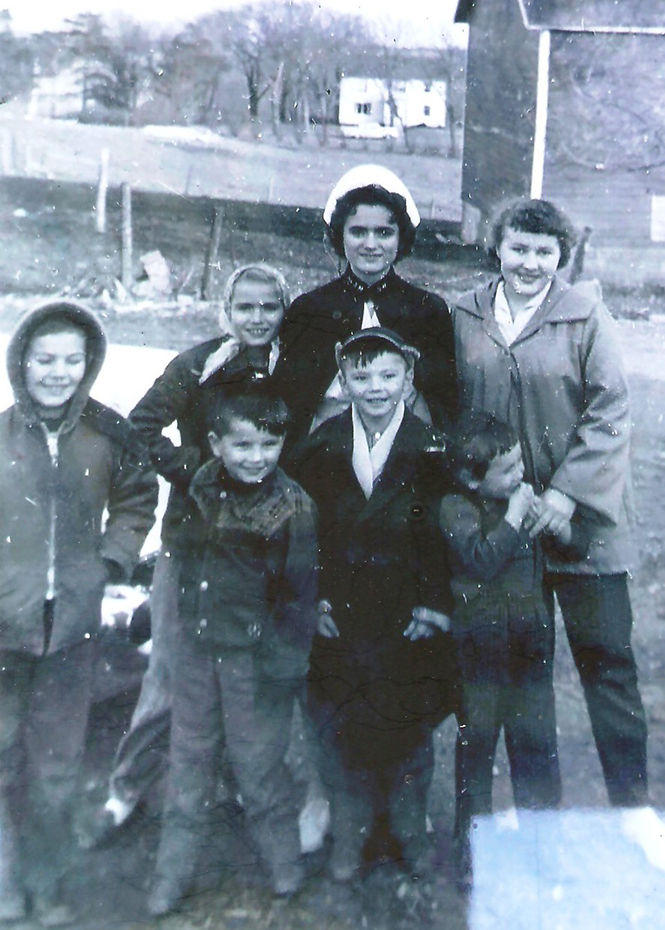
Marie remembered that after class the teacher took her aside and thanked her for speaking out, saying, “It’s about time someone told that bully off!”
Marie remembers many family stories, like the one in which her father, working as a farm hand in Iowa, took a horse out to bring the cows in. Along the path trailed a family of cats – black and white striped. The mother, at the front of the line, had her tail up. Marie’s father came home exclaiming about the beautiful cats – and wondered why his horse would not move another step, no matter what he did.
Marie’s father soon found out what the ‘cats’ were, and why they spooked his horse. They looked like cats to him, but they were actually skunks, not an animal he had seen before. Since wild skunks are native to the Americas, and are not found in Europe, Marie’s father did not know what they were – he had never seen (or smelled) a skunk before! The story of ‘die katzen’ – the German word for cats - became a part of family history.
Marie worked hard, as her father had advised, and not just at her schooling. She remembers a job detassling corn, and that later she moved to the Twin Cities for a job. She had learned shorthand and typing, so she was able to get a job as secretary to a purchasing agent at General Mills. Marie’s goal was to go into nursing; the secretarial job helped her to earn enough money to pay for nursing school.
Marie attended St. Joseph-Mercy School of Nursing in Sioux City, Iowa and Mason City, Iowa. A three-year nursing program, it focused on hands-on training. She remembered that the first three to six months were spent with Craniotomy patients. They did not often speak and were not easy to be around. Marie figured they sent the freshmen nursing students there first to see if they could handle the experience.
“If you could survive that,” she said, “you could do anything.”

In their second year, the nursing students were sent to a psychiatric unit in Dubuque, Iowa. Looking around, Marie noticed there were bars on the windows.
“‘Don’t take the elevator alone,’ they told us,” said Marie. The reason for that, said Marie, was that the psychiatric patients sometimes broke out of their locked wards and there was always fear that they might hurt the nursing students.
Marie graduated from nursing school at the age of 21. She was still a nursing student when she met her husband at the hospital where she was working in Mason City, Iowa. He was a patient who had contracted chemical pneumonia due to a farm accident. It was Marie who nursed him back to health. A year later, they married, and soon started a family, eventually raising five children. Marie now boasts about several grandchildren and many great grandchildren.
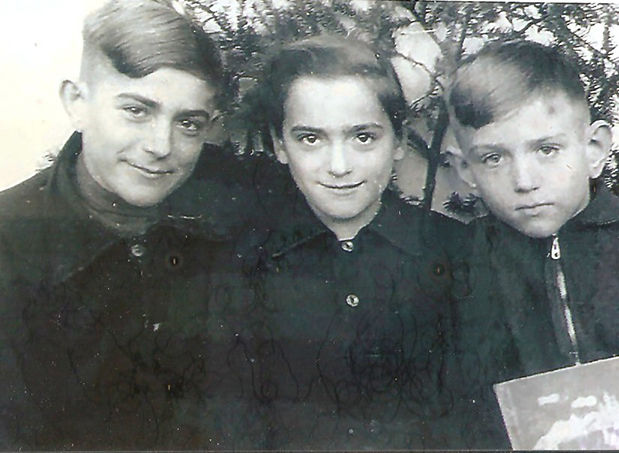
Marie continued working as a nurse in Iowa for 12 years, mostly in the Mason City area. When they moved to St. Cloud, Minn., Marie got a job at St. Cloud Hospital, where she worked for 18 years. She worked for another 12 years at St. Scholastica Convent in St. Cloud, a retirement and assisted living community for the Sisters of the Order of St. Benedict.
All in all, Marie worked as a nurse for 42 years, working in different fields, including being chemo-certified. She retired from nursing at age 63, and then spent time helping her daughter take care of foster children. Since then she has volunteered at the Mother Seton store, a thrift store in Albany, Minn., for almost 20 years.
Although she is now retired from nursing, Marie loves to help people. In the 55+ community where she lives, she often offers to help people, whether they need a ride or just a helping hand.

“When we were young, we were told, ‘Share what you have and do the best you can with everything,’” said Marie. She has always tried to live that way.
Although they did not have much, and the family lived through their share of difficult times, they continued to share, and kept The Golden Rule as one of their most important values.
“Treat others as you would like to be treated,” said Marie. “That’s important.”
Marie and her younger sister consider themselves survivors. They are the last two of the siblings. They don’t live near each other, and don’t see each other very often, but they are still close.
“We lived through all that, you see,” explained Marie, “and we survived.”
One of Marie’s favorite hobbies is knitting. She learned when she was five, and has always loved to knit. She has made hats, sweaters, slippers, afghans, baby outfits, Christmas stockings (even Christmas stockings for pets), and little girls’ dresses. She also makes specialty sleeves (“like a sleeve on a sweater,” said Marie) for people who are going through dialysis, who often report feeling chilly while going through the process. Marie makes the sleeves with leftover yarn and remnants that people give her. Then she donates them through various charities to dialysis centers around Minnesota, including the Mora Dialysis Center (also known as Fresenius Kidney Care Mora), Centracare Dialysis in St. Cloud, and other dialysis centers in the Twin Cities and Duluth.
“We all need a little comfort,” said Marie. “Isn’t that what we need?”


Comments