
Remembering my dad
By Marilyn Salzl Brinkman of St. Joseph
Dads are precious. Sometimes they say or do things that forever change your life. When I sit back and think about my dad, I think back to one specific day.
In the mid-1970s, when I was a beginning writer, I wrote monthly history columns for an agricultural magazine. While visiting my parents one warm sunny day, (By then, they had retired from the farm to the small town of St. Martin.) I noted one of my articles lying on their living room coffee table. My dad picked it up, looked at me in a very peculiar way, and said, “All my buddies are reading your columns, but nobody knows you’re my girl. Your last name isn’t Salzl when you write.”
I was stunned. My dad called me “his girl,” and he wanted me to acknowledge it. He wanted his friends to know that his daughter was a writer. That was the day I decided to include my maiden name in my professional name.
Henry Salzl (often called Hank) was a simple, soft-spoken, hardworking farmer, good-looking, healthy, and strong, with the acorn-brown complexion of an outdoorsman. His hands were callused and worn.
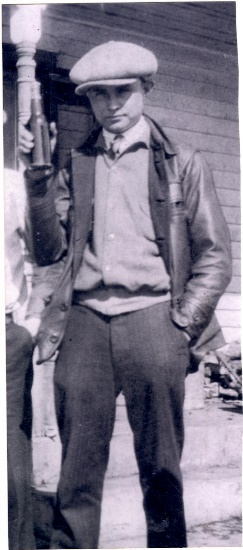
He did not have an easy life as the third oldest of 11 children born on a farm in 1906. He told me in a 1980 interview that, as a young man, he found winters long. He would go walking in the woods by himself, taking the family rifle along. Eventually, he became a hunter and trapper, selling the pelts for income for himself and the family.
With so many brothers and sisters in the home, Henry felt unneeded. After he turned 16, he left home the next three summers to work in the wheat fields of South Dakota. He also traveled to California and Chicago picking up odd jobs, earning a little money as he moved around the country, returning home in winter to hunt and cook moonshine.
His mother, Angela, died of a cerebral hemorrhage when he was 18. Meanwhile, his father, Frank, contracted consumption (TB) and was institutionalized, sent to a TB sanatorium in Walker, Minn., where he died. The family was left without either parent.
Henry was at loose ends, he said. He liked to party and met my mother, Cecilia, at a neighborhood house party. They courted for one year, and one day my mother told me he proposed, saying, “You don’t have anything, and I don’t have anything, so why don’t we get married and see how we can do together.” Both were 20 years old.
Cecilia, too, had a difficult childhood. Her mother died in childbirth when she was three. Together, they successfully farmed north of St. Martin, eventually taking over the family farm. A man of few words, especially about love or affection. At the end of a hard day, Henry would sit down in his sofa easy-chair. If my mother walked into the room, she would sit on the arm of that big chair, and he would immediately put his arm around her. If he came into the house while my mother was bent over the kitchen sink, he often put his hand on her shoulder as he reached for a drink of water from the tap. In my young mind, that translated into loving affection.
He was an avid fisherman. While fishing when I was quite small, I recall him taking my little hands in his as he taught me (and probably each one of his 15 children) how to put a worm on the hook, cast out, and remove the fish. I noted that he had a peculiar little tremor in his hands. It was probably the reason he was such a good fisherman; the line was never still. I copied his little tremor when I tossed out my line. I still do.
Henry could peel an apple or an orange in one long, continuous curl with his ever-present pocket knife. He could fashion a whistle out of a willow branch with that knife. With it, he removed ground-in dirt from my toys as well as from his big farm machinery. Sometimes he cut his fingernails with it.
Time was important to him. He was never late. Sometimes he was too early. When I invited my parents to Thanksgiving dinner at my house after I had small children, they generally arrived an hour early, saying, “We were ready.” I inherited that trait—I’m seldom late, usually early!
In the upper pocket of his bib overalls, I remember well that my dad carried a pocket watch on a tarnished gold fob. I can still see him pulling the watch out of his pocket to check the time. Long after, he and my mother retired from the farm and lived in town. I asked him what happened to the watch. He walked into his bedroom and came out holding it. I asked if I could have it. He laid it in my hand and said, “Nobody else has asked for it.” I treasure it. I’m not sure if it still runs, but that’s not why I have it. I hold it as a dear remembrance of happy times with my dad.
My dad passed away in 1987, quietly, at age 82, in the Albany hospital from a heart attack. (My mother had died three years earlier from breast cancer.) I got there after he had passed. I touched his face one last time and walked away, into a warm July morning, thinking I would never again see his sly smile, hear his hearty laugh, or feel his hands touch me. It was hard leaving. He was my dad, and I was “his girl.” Today, when I sign my name to things I write, I think of him, and I think I am still his girl. And it’s like a butterfly softly breezing past me, a tender, warm feeling. Dads are precious.


Comments